
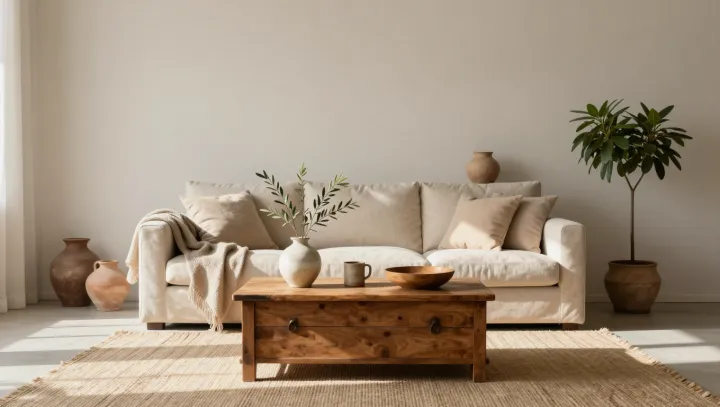
A bare room does not feel serene; it feels unfinished. Warm minimalist living rooms that actually work are built less on restraint and more on tiny frictions between materials, light, and size. One linen sofa, one oak table, one wool rug: the inventory stays lean, but the sensory data does not.
The sharp claim designers quietly make is this: your brain hates flatness more than clutter. Visual cortex research and studies of sensory habituation show that when surfaces share one uniform gloss, color value, and scale, neural firing drops, and the void starts to feel like absence rather than ease. Introduce low-contrast texture shifts—matte plaster against soft boucle, tight-grain wood beside open-weave fabric—and you create just enough variation to keep orientation systems active without triggering alertness.
A second, less admitted truth is that light does more editing than any shopping ban. By tuning luminance gradients and reflectance—think one diffuse floor lamp grazing a wall and one small metallic accent kicking back a concentrated highlight—designers create a hierarchy the eye can follow. This uses the same principle as contrast sensitivity functions in vision science: gentle peaks and valleys in brightness guide attention so the room reads as composed, not vacant.
Scale finishes the job. Oversized art above a low, blocky sofa or a chunky single coffee table in an otherwise open footprint sets up clear figure-ground relationships, a basic concept in Gestalt psychology. You register anchors instead of counting objects. That is why the most convincing warm minimalist spaces rarely depend on owning almost nothing; they depend on engineering the quietest possible set of differences.