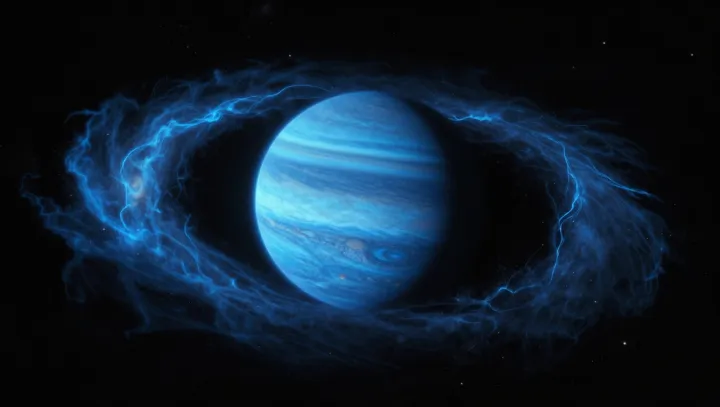
That serene blue disk is lying. From light‑years away, an ice giant compresses into a uniform dot because reflected starlight washes out texture, and telescopes blur everything into a single pixel. At those distances, direct imaging averages clouds, shadows and polar caps into one smooth hue, a kind of cosmic airbrush created by diffraction and limited angular resolution.
Only the spectrum fights back. Astronomers split that faint beam into thousands of wavelengths and watch for minute Doppler shifts and line broadening in absorption bands of methane and hydrogen. Those distortions betray wind shear, jet streams and vertical mixing in the upper troposphere and stratosphere, with models pointing to flows faster than the local speed of sound across latitude bands.
The real surprise is how little information they need. Variations of a few parts per million in transit spectroscopy or high‑dispersion spectroscopy encode rotating storm systems, nightside temperature gradients and even oscillating pressure waves. What looks like a polished marble in a photograph becomes, in the spectrum, a spinning sphere of shock fronts and vortices, its violence legible only to those reading starlight as weather.