
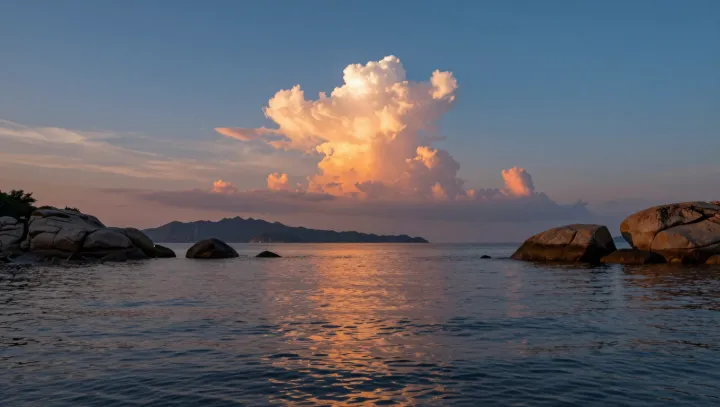
Bare rock should roast. Yet a stark shoreline often undercuts a leafy inland park by several degrees on brutal afternoons, turning stone into the more tolerable option. The physics is blunt: the sea is a massive heat sink with high specific heat capacity, and the coast is plugged straight into it through conduction, convection and evaporation.
The key advantage is not shade. It is ventilation. Over water, air stays relatively cool because liquid absorbs huge amounts of energy with only a small temperature rise, then exports that energy through latent heat as evaporation. As inland surfaces heat up, a pressure gradient builds and a sea breeze forms, pushing cooler marine air horizontally onto the rocky fringe while warmer inland air is lifted away in a continuous convective cell.
Those towering clouds are not decoration. They are active infrastructure in the local energy budget, rising where hot inland air surges upward, then spreading anvils that dim sunlight over both coast and city. Deep moist convection, driven by buoyancy, carries heat and water vapor high into the troposphere, where infrared radiation escapes to space. Under that high white canopy, the rock receives less shortwave radiation than the unshaded park endured earlier, and the onshore flow keeps peeling away the thin warm boundary layer that clings to stone, so the shore stays oddly bearable while the inland park still bakes.