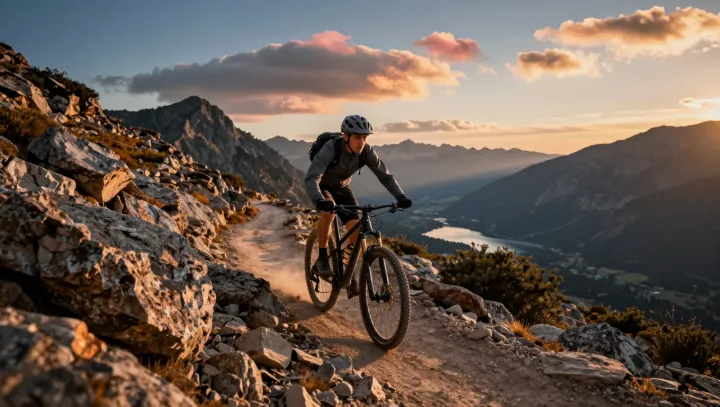
Violence, not finesse, defines a true alpine rock garden. Sharp edges, square hits, chaotic impacts. On this terrain, a rigid death grip is slow. By relaxing the hands and letting the bike rattle, riders turn biomechanics and suspension into a distributed shock system that keeps speed alive instead of killing it at every stone.
The physics is blunt. A locked upper body creates a single stiff structure, so each impact transmits almost directly through the fork, through the head tube, into arms and torso, spiking normal force on the tires and causing micro-losses of traction. A loose grip introduces compliance. Elbows and shoulders act as extra suspension in series with the fork and rear shock, smoothing peak acceleration loads that would otherwise kick the bike offline.
Counterintuitively, control improves when the rider stops trying to pin the frame to one ideal line. With a light hold, the wheels can follow the path of least resistance, guided by tire deformation, contact patch friction and the suspension’s damping curve. The rider’s mass stays relatively stable in space, lowering effective sprung-to-unsprung mass ratio, which stabilizes the chassis over repeated hits.
Energy management seals the argument. Every hard squeeze of the bar, every stiff arm, drains forearm flexors and accelerates neuromuscular fatigue. A relaxed posture offloads work to the suspension kinematics and rubber hysteresis in the tires, preserving grip strength for braking and steering when it actually matters. The fastest line, on the harshest rock, is the one that lets the bike dance while the rider stays calm.