
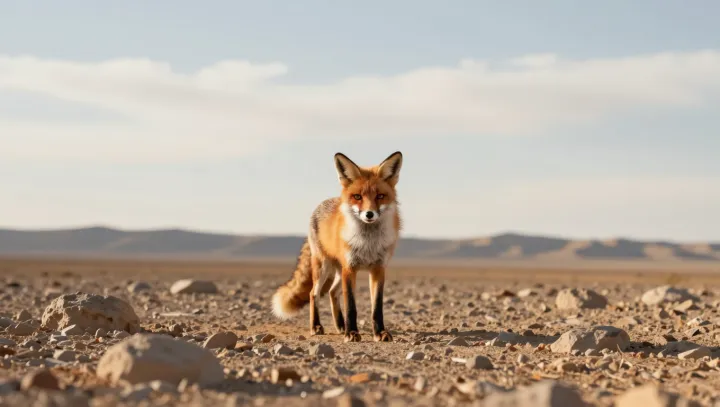
Harsh rock plains, not soft snowfields, best reveal the red fox’s winter engineering. Bare stone offers no shelter, so every hair on that compact body must act like mobile infrastructure against convective heat loss and abrasive wind.
The key advantage is not simple thickness. Instead, a dense underfur layer creates a boundary layer of still air, while longer guard hairs form a coarse outer shell that deflects wind shear and drip‑sheds freezing moisture. That two‑tier architecture increases effective thermal resistance, or R‑value, without adding heavy mass that would slow agile movement over fractured rock. Shorter leg fur reduces snow clumping but leaves joints free, important when the animal must spring between ledges rather than plow through drifts.
Equally strategic is how the coat manages microclimate. By piloerection, the fox alters hair angle, expanding or compressing trapped air much like a variable‑insulation parka tuned by autonomic nervous control. Darker guard hairs absorb scarce solar radiation on exposed slopes, while the paler underfur limits re‑radiative heat loss through countershading. Combined with a compact body shape and reduced extremity surface area, the coat works as a distributed heat‑exchange system, allowing the animal to curl on open rock, shield vital organs from wind, and still retain the fine sensory hairs it needs to detect prey under thin scree.