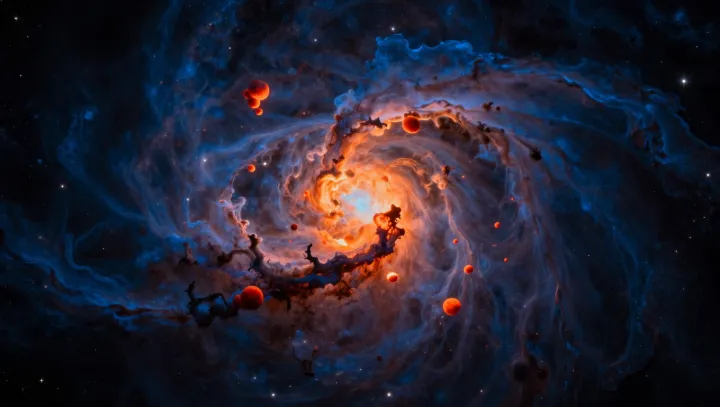
Ancient galaxies are not dead; they are overachievers that refuse to cool. Their star factories shut down long ago, yet their cores still pour out enough energy to heat and expel surrounding hydrogen that might otherwise collapse into new galaxies.
The harsh truth is simple. Once a galaxy builds a dense stellar bulge and a massive supermassive black hole, it locks in a thermal regime that is hard to reverse. Old but compact stars, especially white dwarfs and hot subdwarfs, emit ultraviolet radiation that keeps circumgalactic hydrogen ionized, while accretion onto the central black hole powers active galactic nucleus jets that stir and shock the gas over enormous distances.
The result is brutal. Gas that should cool via radiative cooling instead stays in a high entropy phase, blown into tenuous halos where its density is too low for gravitational collapse. Observations of X‑ray emission and Lyman‑alpha absorption show halos of hot plasma around these quiescent systems, clear evidence that mechanical feedback and photoionization are still running long after star formation stopped.
So ancient galaxies shine like space heaters in a nursery that never opens. Their long‑lived stars and black holes together maintain a hostile thermal bubble, stripping away or sterilizing the cold hydrogen that young galaxies would need to be born.