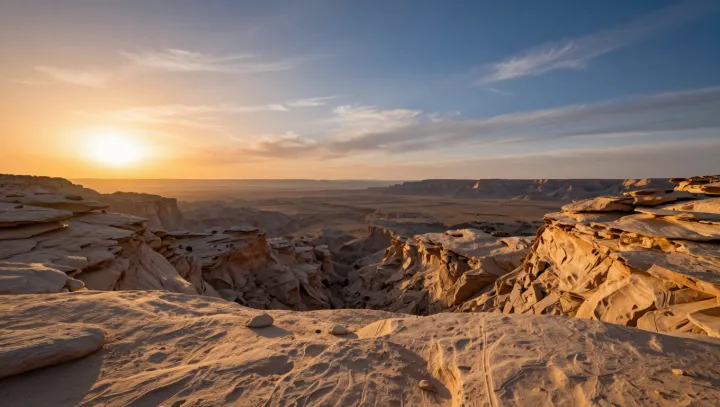
Low sun does its best work when it looks the weakest. At a shallow solar angle, incoming radiation must cross a longer air column, so much energy is scattered and skin feels little change, yet the remaining oblique rays strike the ground with extreme directional bias and turn every millimeter of relief into a sharp boundary of light and shade.
What seems like a flat badlands plain is already a maze, and the sun simply exposes the draft. Differential erosion, driven by variations in mineral hardness and cementation, has etched micro-relief into the sediment. Thin resistant beds form caprock on mesas, while softer strata yield to mechanical weathering and fluvial incision, pre-cutting the surface into tiers, ledges, and incipient gullies that midday light tends to wash out.
The real trick is contrast, not power. Low-angle illumination lengthens shadow geometry, boosts local luminance gradients, and exaggerates albedo differences between clay, silt, and sandstone. Human visual processing, tuned to edge detection and contrast enhancement, then stitches these elongated shadows into apparent razor-thin ridges and endless plateaus, so a weak sun that barely warms a hand can redraw an entire horizon.