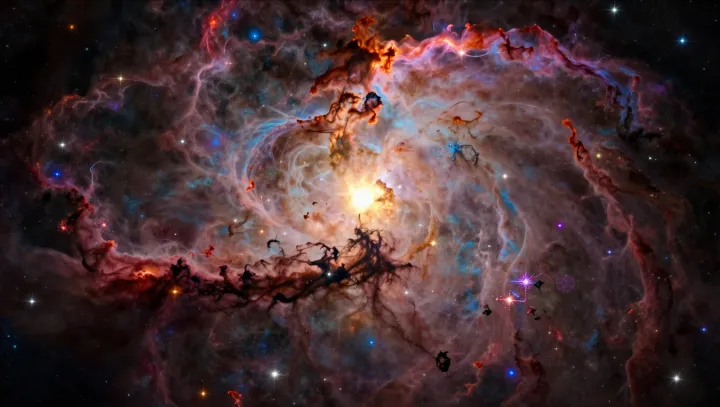
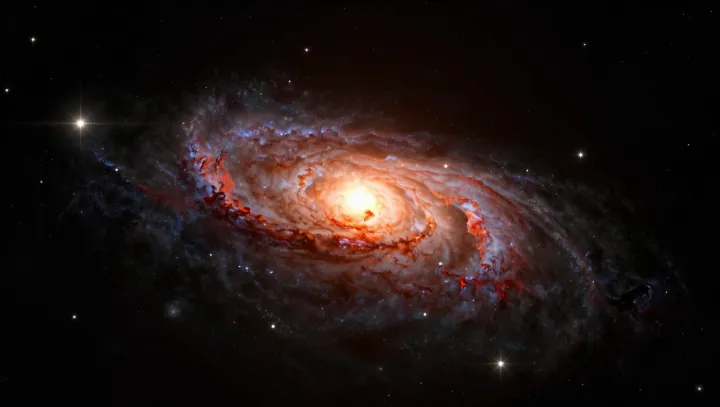
Dark dust lanes are not the galaxy’s scars. They are its case files. Against the bright spiral disk, those jagged shadows flag where cold molecular gas piles up and where starlight is selectively absorbed, turning simple images into layered records of density, chemistry and motion.
The striking claim is that these obscuring bands work like a forensic logbook. Radiative transfer models, paired with multiwavelength maps from radio to ultraviolet, let astronomers translate each filament’s extinction into gas mass and metallicity, while Doppler shifts from spectral lines trace how that material orbits, shears and collapses. Short sentences matter here. Sharp bends and breaks in the dust pattern reveal past tidal encounters, bar instabilities or minor mergers, each leaving a distinct imprint on angular momentum and spiral structure.
Even more provocative is the idea that dust encodes time. Gradients between dust-rich arms, ionized hydrogen regions and older stellar populations mark the sequence of star formation as density waves sweep through the disk, offering a clock tied to stellar evolution and nucleosynthesis rather than any calendar. What seems like a dirty smudge on a postcard view is, under spectroscopy and high-resolution imaging, a layered archive from which an entire formation history can be reconstructed.