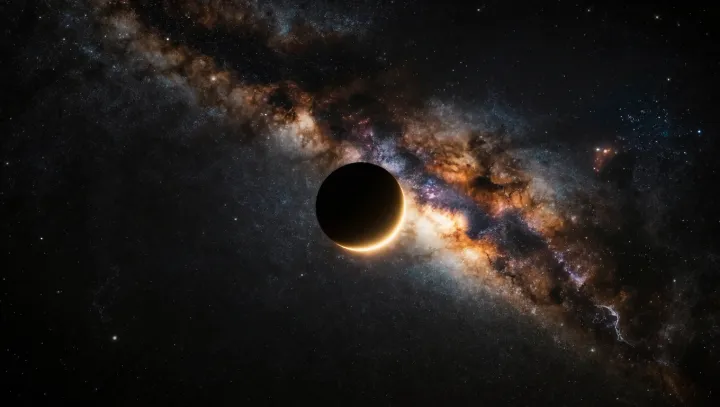
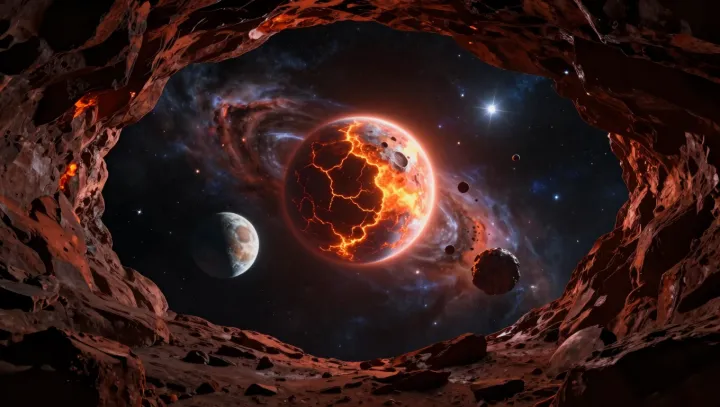
A molten planet should look chaotic, yet its gravity can be ruthlessly orderly. A young world still hot enough to glow like lava already carries a deep gravitational well that cares nothing about crust or oceans; what matters is mass, not maturity, so nearby dust, ice and rock feel the same pull they would from a quiet, frozen globe.
The surprising part is not that rings form, but how quickly they organize. Close to the planet, tidal forces and differential rotation grind debris into a flattened disk, while beyond the Roche limit loose clumps survive and begin to accrete. In that disk, inelastic collisions and orbital resonances act as a slow sorting machine, damping random motion and encouraging material to gather into dense moonlets, even as the surface below still roils with magma oceans and intense thermal emission.
The harsher the environment, the more efficient the sculpting becomes. Strong tidal heating, rapid spin and a powerful magnetosphere stir the circumplanetary disk, yet they also set clear orbital resonances that shepherd particles into arcs and gaps. Over long spans, those structures can harden into full moons, locked into stable orbits that remember the planet’s violent youth long after its lava glow has faded.