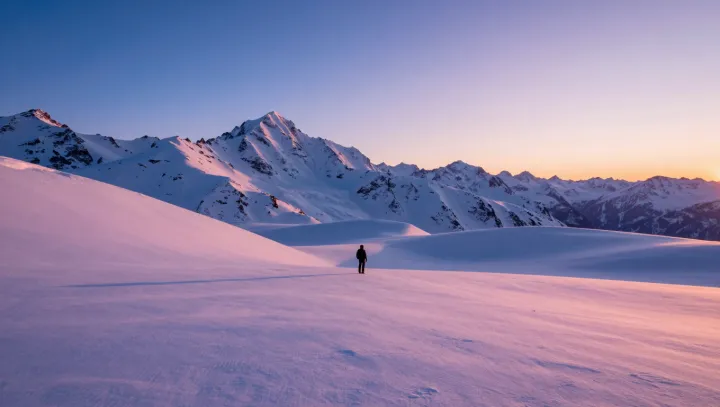
Twilight on a snowfield is more hostile than a shrieking storm. In the hush, the mountain turns into a cold sink, and the hiker becomes its slow fuel. Without sun, the ground and sky act as vast radiators, and the body loses heat by thermal radiation and convection into an air mass that feels harmless because it is calm.
Counterintuitively, a loud storm can be safer. Strong wind stings, noise alarms, and blowing ice screams danger, pushing a hiker to move, to seek shelter, to watch the clock. In a still scene, metabolism drifts downward as walking slows, peripheral vasoconstriction shunts blood from fingers and toes, and core temperature slides while the victim believes they are merely tired.
Even more insidious is what twilight does to distance. With the sun gone and contrast flattened by snow, the visual cortex loses reliable depth cues such as parallax and texture gradients. A ridge that appears minutes away can, in photopic-to-scotopic transition, be an hour’s trudge. That misread gap, combined with progressive hypothermia and impaired executive function in the frontal cortex, is why the quiet evening traverse often kills where the midday storm only scares.