
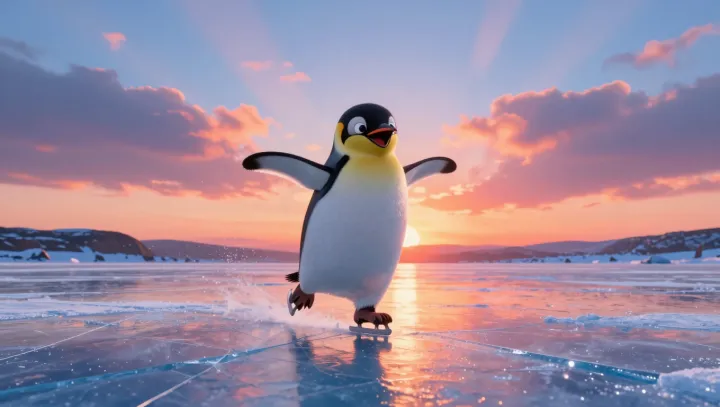
Snow does not care about charm. Against that indifference, a baby penguin still wins by treating its own body as both vehicle and ballast, using contact with the ice the way a bobsled uses steel runners, only spread into a soft, wide pad.
The glide looks like play, but it is a calculated surrender to physics. By dropping onto its belly, the chick lowers its center of mass until it almost hugs the surface, which boosts stability and slashes the risk of tipping. That posture also enlarges the contact area, so the pressure on any tiny patch of ice falls, keeping the surface from biting back with high static friction. A short push from clawed feet or a flick of stubby wings supplies the initial impulse; after that, inertia does most of the work while kinetic friction quietly bleeds speed at a manageable rate.
Clumsiness is a myth here. The chick’s rotund shape spreads weight like a well-designed airbag, while its down feathers trap a thin layer of air that works as low-grade insulation and a crude lubricant film. Subtle shifts of flippers act as micro rudders, adjusting torque around the center of mass to keep motion in a straight line rather than a spin. What looks like a fuzzy torpedo on holiday is, in mechanical terms, a self-stabilizing, low-slung sled exploiting friction, normal force and momentum with remarkable efficiency.