
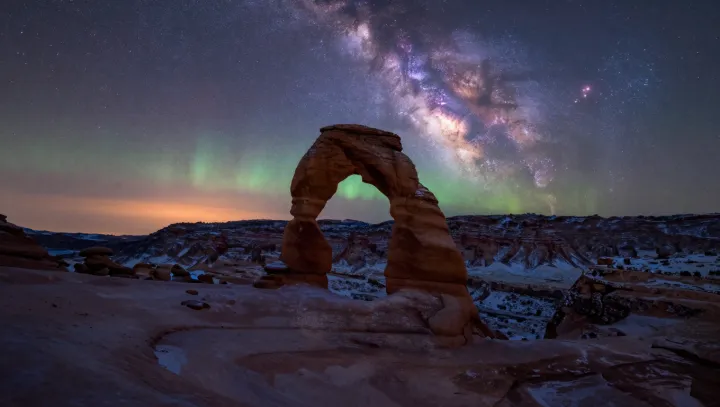
That double exposure in the sky is not a trick; it is basic physics laid bare. Above a frozen desert, the Milky Way rides as distant starlight, while the green smear is energy dumped into nearby gas. One picture. Two very different light sources sharing a frame.
Key to the coexistence is separation in both distance and altitude, not any exotic interaction. Galactic light travels across interstellar medium for immense spans, passes through the heliosphere, then Earth’s atmosphere, and still arrives bright enough for dark-adapted eyes and long camera exposures. At the same time, charged particles guided by Earth’s magnetosphere crash into the upper atmosphere, mainly into atomic oxygen around a specific altitude band, driving electron excitation and the characteristic green emission line near 557.7 nanometers.
The surprise, if there is one, is how little these processes interfere with each other. Aurora forms in a thin shell high above most scattering air molecules, so even active displays rarely wash out the full Milky Way; they act more like a moving veil than a floodlight. Long exposure photography then amplifies both the integrated galactic light and the faint auroral photons, revealing structure in the stellar disk and in geomagnetic field lines at once. What looks like a single quiet sky is actually a stacked cross section, from galactic disk to magnetospheric theater, projected on one cold canvas.