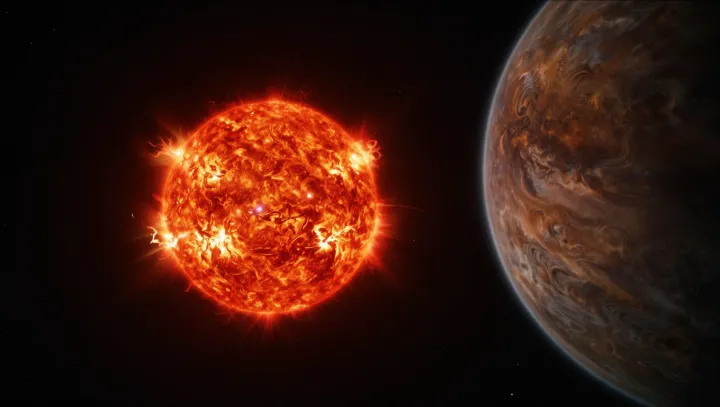
Darkness, not Earth, steals the spotlight in the new portrait of the Solar System built entirely from telescope data. The image compresses planetary orbits, reflected starlight, and thermal emission into a single frame, rendering our home system as an exoplanet survey would see it: one bright star, several dim points, structured noise all around.
What unsettles many researchers is how boring this picture looks. Photometry and radial‑velocity signatures extracted from the composite match the blur of distant planetary systems already catalogued by transit surveys and spectrographs, suggesting that a rocky world in the temperate zone is not an exotic outlier but a statistical expectation once gas giants and inner rubble are in place.
The stronger claim is bolder still. If Earth’s biosphere leaves only subtle fingerprints in broadband flux and reflected color, and those signatures vanish into the scatter of ordinary exoplanet data when the system is shrunk to a few pixels, then current occurrence rates for Earth‑like planets imply that similarly quiet, life‑bearing worlds could be widespread yet observationally mundane.
So the image functions less as art than as a control experiment. By turning the Solar System into just another data point in population synthesis models and Bayesian habitability estimates, it weakens the old intuition that life here must be a freak exception and strengthens the competing view that the real anomaly may be our lingering doubt.