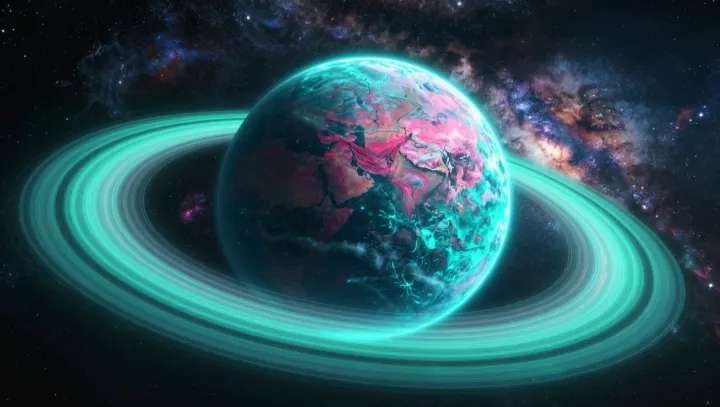
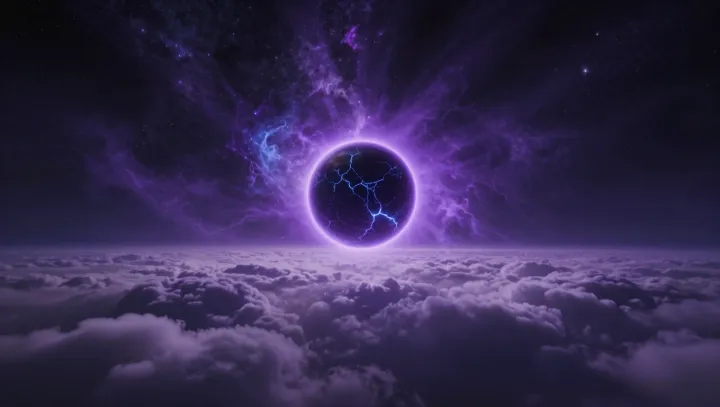
That glowing world above a hazy horizon is not stable at all. It is falling. Every point of its orbit is a controlled failure to hit the star it circles, a balance set by orbital velocity against gravitational acceleration. Increase the sideways speed and the planet climbs; decrease it and the path tightens toward the central mass in a measurable, predictable way.
The common story that gravity pulls things simply “down” misses the sharper claim from general relativity: mass curves spacetime, and planets trace geodesics, the straightest possible paths within that curved geometry. What looks like a stationary globe hanging in the sky is actually in continuous free fall, its inertia forever trying to move in a straight line while spacetime itself bends that line inward, locking motion and curvature into a single, shared trajectory.
The odd part is that no extra support is needed. No hidden force pushes outward to counter gravity; there is only the inward pull and the sideways rush. From a surface, the planet seems to hover at one fixed height, yet its entire bulk is engaged in an orbital dance where kinetic energy and gravitational potential energy trade roles, letting that bright disk linger above the clouds instead of slipping silently into the dark.