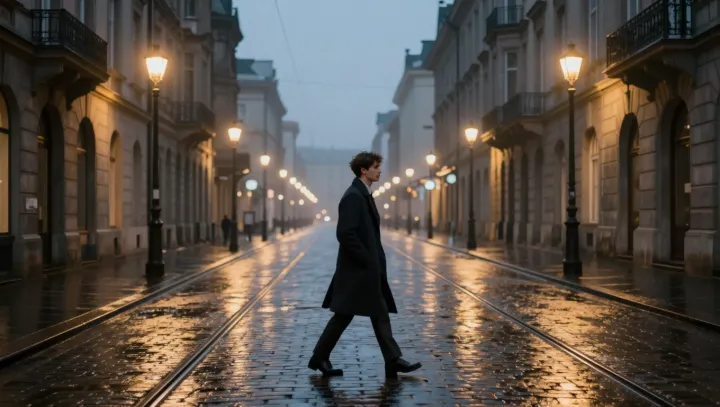

Lantern light in mist is not romantic scenery; it is a filter. Dim, narrow light cuts visual input, rain softens sound, and slow walking drops motor intensity. What is left is a low‑noise channel for the brain systems that sort long arcs of life rather than instant rewards.
Clearer long‑term judgment begins where sensory overload ends, because the prefrontal cortex and hippocampus depend on stable signal‑to‑noise ratios to integrate memory, valuation and future planning. Bright, crowded spaces flood the thalamus and visual cortex with high‑contrast motion, forcing attentional networks into constant orienting and short‑horizon threat checks. Under a lantern, peripheral detail fades, alpha oscillations rise, and the default mode network can sustain long internal simulations without being reset by every passing stimulus.
The key advantage of solitary walking is not exercise; it is bandwidth allocation. Repetitive, moderate movement engages cerebellar and basal ganglia circuits almost automatically, freeing metabolic resources and working memory for counterfactual thinking, value comparison and delay discounting control. Noise and speed push dopamine toward immediate cues; quiet and slowness let serotonergic and prefrontal circuits weight distant payoffs. Mist and darkness enforce monotasking. Fast, bright commutes optimize reaction time. Lantern walks, by design, optimize reflection on what will still matter when the road is dry.