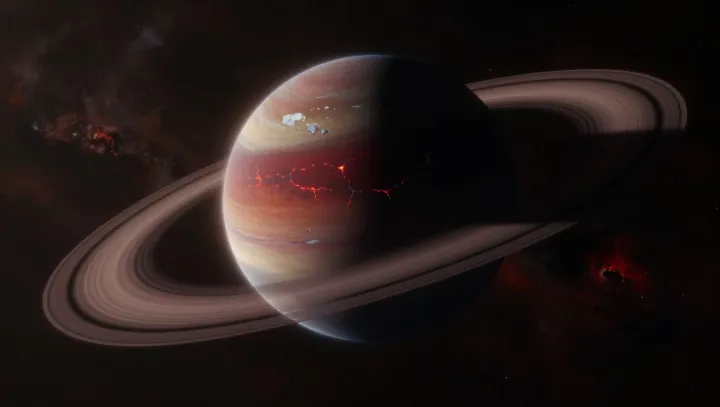
Saturn’s rings are not fragile ornaments; they are an industrial grinder in orbit. Bright arcs of ice and rock stretch across hundreds of thousands of kilometers, yet the main rings stay only tens of meters thick because gravity, collisions, and rotation act together like a relentless flattening press that never switches off.
The key is ruthless sorting. Each particle obeys Keplerian motion and differential rotation forces nearby chunks into near-identical orbital planes, while Saturn’s gravity pulls vertically, damping any tilt. Tiny vertical motions get punished: frequent inelastic collisions convert that vertical kinetic energy into heat and slight radial spreading, so anything that strays above or below the plane is quickly knocked back toward it.
Equally important is Saturn’s supporting cast of moons. Embedded moonlets and exterior satellites set up resonances and gravitational perturbations that shear away thick clumps, enforcing a geometrically thin disk instead of a puffed-up torus. Viscous spreading, self-gravity wakes, and angular momentum transport keep the system active but flat, leaving a structure that is wide as a miniature solar system and yet, by cosmic standards, thinner than a sheet of paper.