
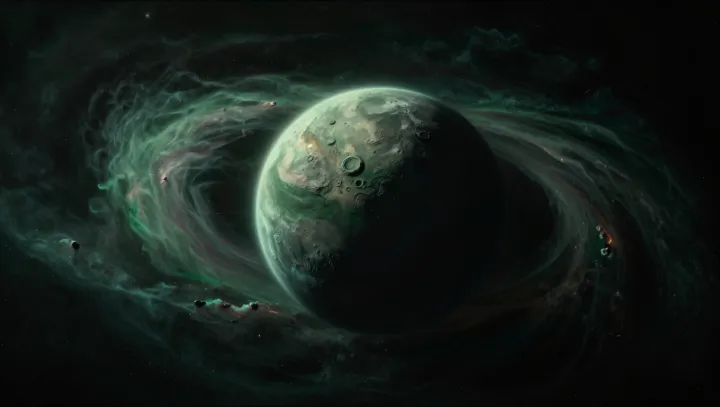
A brief, silent flare in a distant star’s glow is the loudest clue these planets ever give. No orbit. No host star. Just a tiny spike in brightness that vanishes almost as soon as it appears, leaving only a trace in the data streams of robotic telescopes.
The bold claim is this: from that spike alone, astronomers can infer a dark, starless world. At work is gravitational microlensing, where a planet’s mass bends spacetime and acts as a lens, slightly amplifying the background star’s light in a pattern that general relativity predicts with unforgiving precision. The event produces a characteristic light curve, its rise and fall encoding the lens mass and its motion across our line of sight. Because the planet emits almost no light of its own, only this temporary magnification betrays its presence.
What sounds like guesswork is instead a numbers game run at industrial scale. Wide-field surveys sweep dense star fields continuously, chaining observatories across longitudes to avoid gaps, then feed billions of brightness measurements into pipelines tuned to pick out microlensing signatures shorter than a heartbeat. Events lasting only hours signal low-mass lenses, often consistent with free-floating planets rather than stars. When follow-up data rule out a stellar host and parallax or finite-source effects refine the model, the remaining explanation is stark and oddly elegant: an unseen planet, wandering alone, briefly turned a distant star into a precision instrument.