
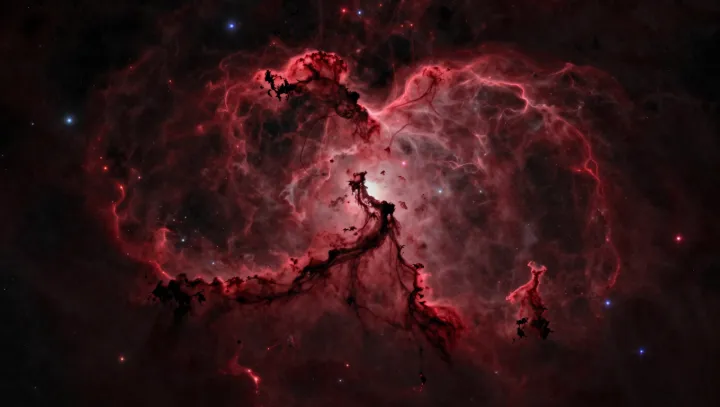
Barely decorative at all is that glittering sky; it is a calibrated instrument. Every point of light obeys blackbody radiation, the same physics that lets an engineer read a furnace by color, so a blue star broadcasts a far hotter surface than a red one, not as metaphor but as thermometer, with the spectrum acting like engraved numerals.
Counterintuitive, though, is how little equipment this thermometer needs. A blue giant can blaze above ten thousand kelvin, while a red dwarf may sit near three thousand, and that gulf is encoded in spectral type labels like O, B, and M that astronomers treat as temperature bins rather than poetic tags. Human vision, tuned to wavelength, already sorts those bins: shorter, bluer wavelengths carry the signature of higher thermal emission, longer, redder ones of cooler photospheres, so your casual glance is running a crude colorimetry experiment without filters or CCDs.
Most surprising of all is how much your eyes leave on the table. They compress a continuous Planck curve into a quick impression of “blue” or “orange” while spectrographs pry it apart into absorption lines and exact effective temperature values, yet the hierarchy remains the same, visible to anyone who simply looks up. On a clear night the sky is not a random scatter but a temperature scale hung overhead, and you are already reading it, whether you claim to be doing physics or not.