
A silent corridor can feel more aggressive than a speeding train. In a long, rigidly symmetric hall, parallel lines of floor tiles and ceiling seams feed the brain a textbook case of linear perspective, so neurons in visual cortex fire as if the world is rushing past, even when every atom of concrete stays fixed.
The odd part is that the mistake is not a bug but the default setting. Depth-perception circuits evolved to read optic flow and parallax as you walk, combining tiny shifts on the retina with contrast edges and vanishing points to estimate self-motion, and a hallway concentrates those cues into a single, exaggerated axis that the system is too impatient to ignore.
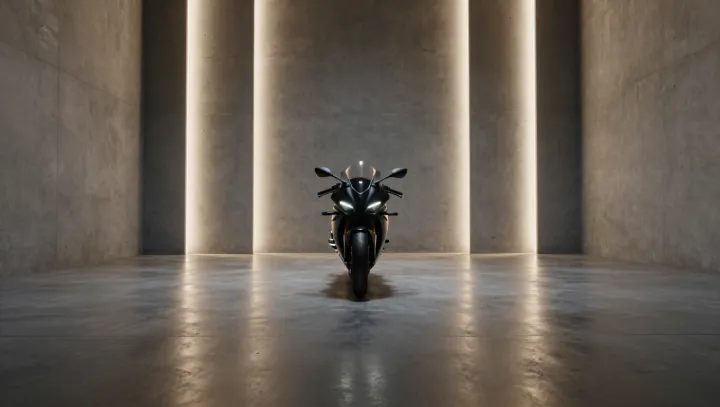
Design does some of the pushing. Strong luminance gradients, glossy reflections, and repeating door frames create high-frequency spatial frequencies that drive area MT and other motion-sensitive regions, while the vestibulo-ocular reflex stays quiet, so the brain tries to resolve the conflict by inventing a gentle pull, a phantom glide along the corridor’s spine.
What feels like a subtle mood is really a forced choice. Either the hall flexes and bends, which the visual system treats as structurally impossible, or you are the one sliding forward, so the architecture wins the argument and your sense of bodily stillness quietly loses.