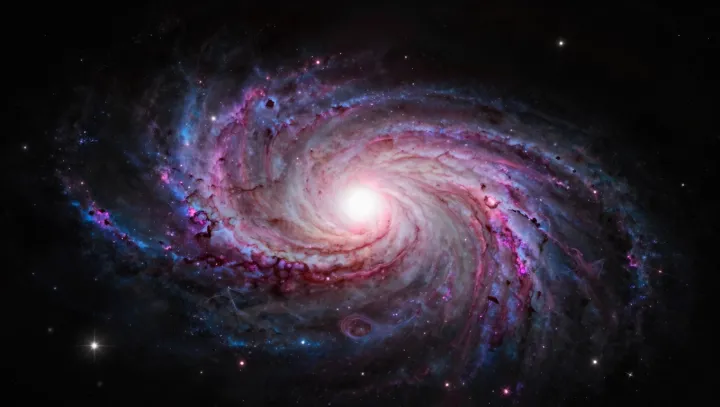
A perfect ring in space is often anything but peaceful. What looks like a neatly lit halo is, in many cases, the visible scar of a direct hit, when one galaxy plunged almost straight through the disk of another and turned ordered rotation into a radial shock front.
At the heart of this story is violence, not symmetry. During a near head‑on encounter, the intruder galaxy passes through the target disk, its gravity yanking stars and, more importantly, cold interstellar gas out of their regular orbits. That jolt launches a circular density wave that races outward through the disk, rather like a pressure pulse in a fluid, even though the underlying medium is a sparse mix of hydrogen and dust.
The bright ring is not a rigid structure at all; it is a moving front. As the wave travels, it compresses gas clouds, pushing them above the threshold where gravitational collapse overwhelms internal pressure. Astrophysicists describe the result as a collision‑induced starburst, a ring of short‑lived massive stars that light up the shock. Behind the wave, the disk can look oddly depleted, while ahead of it the gas still waits, untouched, for the oncoming ripple.