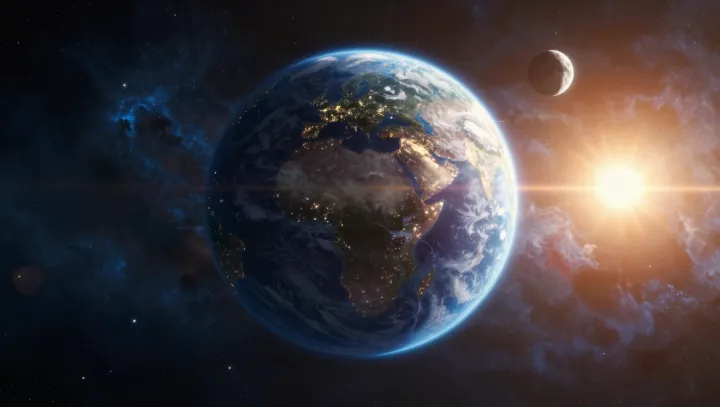
Cold, here, is badly underrated. A dark nebula sitting just above absolute zero does not freeze chemistry; it slows it to an almost bureaucratic crawl in which every transaction still goes through. Gas thins to a near vacuum, photons vanish, and dust grains only a fraction of a micron wide become the main stage for molecular drama.
The key claim from astrochemistry is blunt: surfaces win. On those silicate and carbonaceous grains, atoms stick, shuffle, and combine through surface diffusion, so activation energy drops compared with reactions in the gas phase. Hydrogen atoms, absurdly light, wander across the lattice, meeting oxygen or carbon and building water, methanol and other organics that would stall in colder gas alone.
Even that is not generous enough; physics cheats. Quantum tunneling lets particles cross reaction barriers they classically should bounce off, a process formalized in reaction rate equations using tunneling probability instead of simple Boltzmann factors. At the same time, low‑level ionization from cosmic rays creates reactive ions and radicals, so ion‑molecule chemistry and radiative association proceed despite the chill, each event rare, but integrated over vast volumes and times, surprisingly productive.