
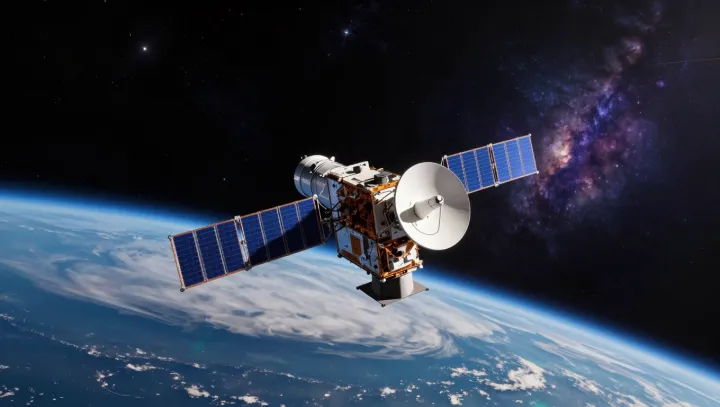
Orbital arrival is the real test; the cruise is almost trivial by comparison. Coasting through interplanetary space mostly exploits initial impulse and Newtonian inertia, with only small trajectory correction burns adjusting the heliocentric transfer orbit. The hard part comes when a spacecraft must shed enough kinetic energy, relative to a target world, to be captured rather than simply slingshot past on a hyperbolic path.
The core problem is delta-v economics. To drop from a fast flyby trajectory into a bound orbit, a vehicle must perform a substantial retrograde burn, converting orbital energy into waste heat in its propulsion system or into atmospheric drag if aerobraking is possible. Propellant mass follows the exponential rocket equation, so every extra meter per second of required braking multiplies launch cost, payload trade-offs and risk to the mission architecture.
Even gravity assist, often praised as a free boost, is unforgiving when used for braking. A poorly tuned flyby can increase velocity relative to the target body instead of reducing it, because the vector geometry of the three-body problem controls whether the assist steals or adds orbital energy. Mission designers therefore choreograph intricate sequences of burns and flybys to arrive with just enough speed, at just the right angle, for engines or atmosphere to finish the capture.