
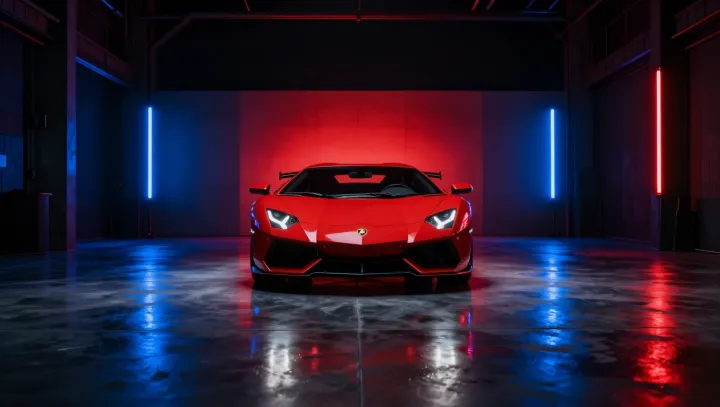
Wet asphalt does most of the bragging before the engine ever does. On a studio floor soaked to mirror sheen, lighting crews turn a parked supercar into something that feels mid-sprint, using tools that stunt real racetrack footage into looking strangely tame.
Speed, they argue, is a light problem, not a horsepower problem. Hard, raking beams skim across bodywork to create rapid specular highlights, then are dragged along sliders so reflections streak like motion blur even though the chassis never moves. High contrast ratios push the car toward chiaroscuro, while flags and barn doors carve out razor edges on fenders and air intakes, exaggerating aerodynamics that a flat, overcast circuit camera simply flattens out.
Authenticity, in this trade, is less honest than it sounds. A glossy, watered floor becomes a controllable proxy for wet tarmac, doubling every headlight and taillight as elongated reflections that mimic long-exposure photography and retinal persistence. Gobo patterns simulate sodium-vapor street spill or tunnel flicker, feeding the viewer’s motion detectors in the visual cortex even in a frozen frame. Add a tiny layer of controlled grime with polarizing filters set off-axis, and the same studio car suddenly looks not just fast, but road-tested in ways a distant, wide racetrack shot rarely conveys.