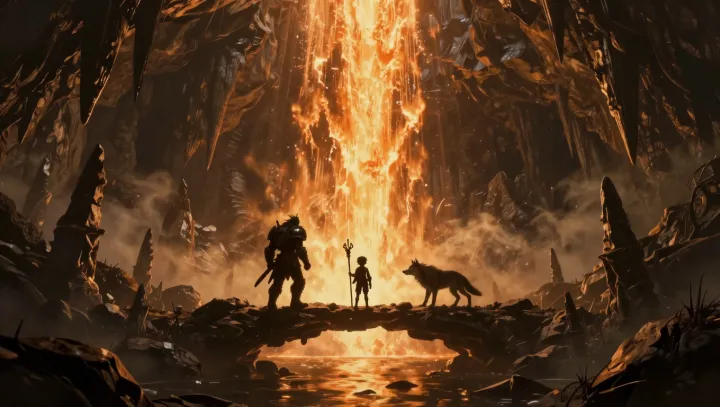
A lavafall would disappoint as a cave lamp. The glow looks fierce, yet the physics behind it is stingy with visible light and generous with heat. Molten rock sits near the temperature where blackbody radiation starts to creep into the visible band, so it shines, but most of its electromagnetic output still leaks away as infrared.
That mismatch is the key. Your eyes are tuned to a narrow slice of wavelengths, while a lava stream at roughly one to two thousand kelvin dumps the bulk of its radiative power outside that slice. Luminous efficacy, the ratio of visible flux to total radiant flux, stays low compared with a hotter filament or the photosphere of a star. The rock is not shy on watts. It is just wasting them at wavelengths you barely register.
The second surprise is geometric, not thermal. Daylight floods a cave only when the entrance acts as a giant diffuse source, lighting every surface from many angles. A lavafall, no matter how dramatic, is a compact emitter. Its luminous intensity drops with the inverse square law, and its light skims past corners instead of wrapping around them. Shadows stay hard. The ceiling stays murky. The scene reads more like a torchlit tunnel than an outdoor plaza.
So the cave would look alien, not sunlit. An overbright stripe of orange, a pool of harsh reflections on nearby rock, and a rapid slide into darkness just a few body lengths away.