
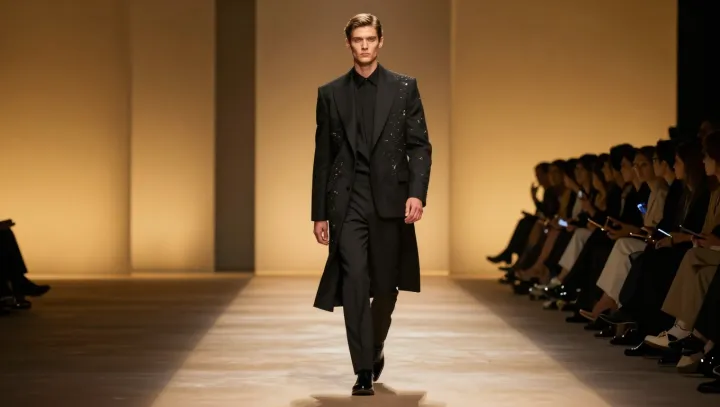
One coat wins. The crowd loses. In visual science, this is not drama but baseline operating procedure, as neurons in the primary visual cortex fire more vigorously for sharp differences in brightness and color than for uniform fields of faces and fabric.
What looks like style is really circuitry. A dark, gold-flecked coat under warm spotlights creates extreme local contrast, and that contrast is what edge-detection cells and orientation-selective columns are tuned to exaggerate, building a high-gain signal while the rest of the scene is averaged into statistical background. High luminance on those metallic flecks drives photoreceptors and retinal ganglion cells to produce a spiky pattern of activity that climbs the visual hierarchy, where salience maps in the parietal cortex bias attention toward that single illuminated target.
Memory then cheats in the same direction. Episodic encoding in the hippocampus favors items that have already been singled out by attention and by reward-like novelty signals, so the spotlighted coat receives dense synaptic tagging while the crowd is stored as a blurred ensemble. The brain is built not to record everything, but to overrepresent what breaks the pattern of light.