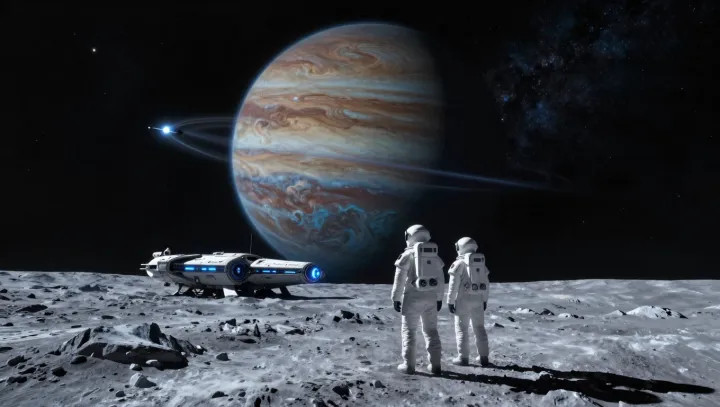
Dominance here is not about size in the sky; it is about control of motion. The gas giant hangs low, swollen and bright, yet its real power runs through invisible vectors of gravitational acceleration that never switch off.
Tidal flexing, not impact scars, is the main sculptor of this moon’s interior. With each orbit, varying gravitational potential stretches and compresses the rocky shell, forcing frictional heating in the lithosphere and mantle, driving cryovolcanic fissures or sulfurous plumes where simple cooling should have left a frozen husk.
What looks like a quiet orbit is in fact a negotiated truce. Orbital resonance with neighboring moons locks in eccentricity, preventing the path from circularizing, so the changing tidal field keeps pumping mechanical energy into the crust while the gas giant’s Hill sphere defines which fragments stay, which escape, and which rain back as regolith.
Even the ground under a suited observer’s boots is a ledger of these forces. Fracture networks trace stress fields; subtle libration betrays the shifting torque; tiny variations in surface gravity, measurable by gravimetry, map buried oceans or differentiated cores that exist only because the distant giant keeps kneading this world like slow, relentless machinery.