
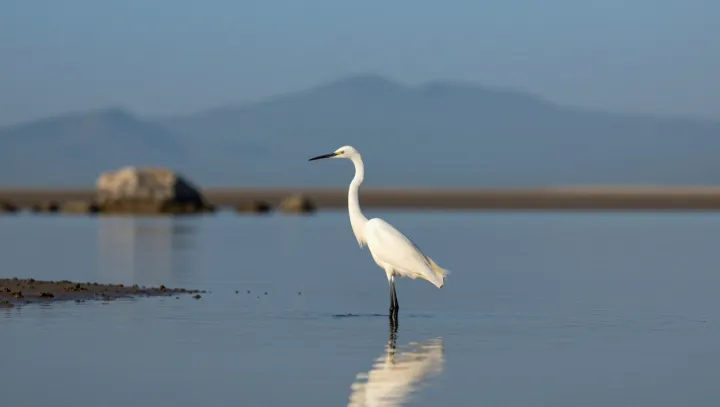
Stillness, here, is not calm but weapon. A fishing bird stands above dark water, body almost locked, feathers barely shifting while its head fixes on a single wavering target below the surface. What looks like effortless waiting is in fact tight neuromuscular control, tiny postural muscles firing in constant micro-adjustments to counter ripples of wind and its own heartbeat.
Speed, ironically, is stored in that silence. In the neck, collagen-rich tendons work as biological springs, loading elastic potential energy while larger muscles contract slowly and efficiently. When the brainstem motor circuits release that tension, the head and bill accelerate like a snapped crossbow limb, reaching peak velocity in less than the time a human eyelid needs to close. Electromyography and high-speed videography show a clear pattern: long periods of low-level isometric contraction, followed by a brief ballistic burst.
Accuracy is the third, often ignored, ingredient. Specialized photoreceptors and fast visual processing in the optic tectum let the bird predict how refraction will bend the apparent position of a fish and how water drag will resist the bill. The strike is not a reflex lunge at where the prey is, but a precomputed trajectory toward where it will be when steel-hard keratin meets flesh.