
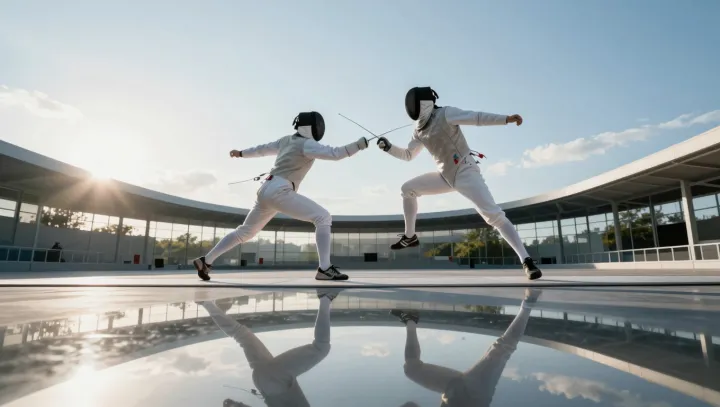
Impact, not elegance, is the secret engine of elite fencing. Each airborne lunge slams the front leg into the strip with ground reaction forces several times body weight, yet injury rates in top squads stay lower than those numbers suggest, because the body quietly runs a sophisticated impact‑control script.
The real trick is that fencers never truly land stiff. Ankles, knees and hips flex in a rapid sequence, turning what could be a single violent spike into a longer force curve; in biomechanics labs, motion capture and force plates show that milliseconds of extra contact time meaningfully cut peak load on articular cartilage and subchondral bone. Quadriceps and calf muscles fire eccentrically, acting as biological shock absorbers, while the Achilles tendon stores elastic energy and releases it into the quick retreat or follow‑up attack.
More interesting still is how the nervous system anticipates the crash. Anticipatory postural adjustments, measured through electromyography, prime specific motor units before the front foot hits, so joints arrive already braced yet mobile. Trunk rotation and arm position subtly shift the center of mass, redistributing deceleration away from a single joint. That choreography exposes a larger principle: when stop‑and‑go is unavoidable, safety depends less on avoiding force and more on spreading force across time, tissue and direction, turning every landing into a controlled fall rather than a collision.