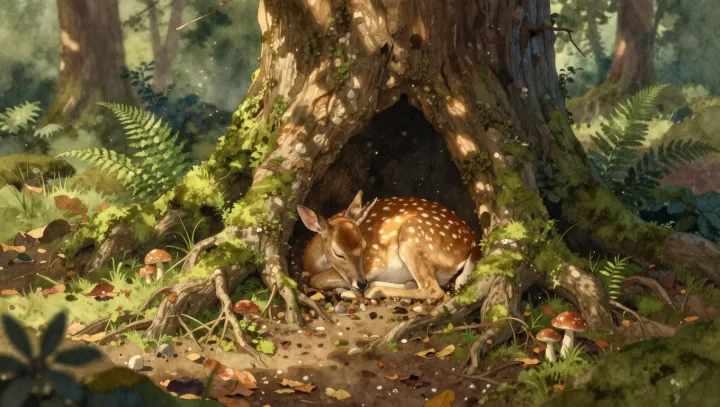
That painted fawn is not innocent at all. It hijacks neural systems that once tracked predators and shelter, pressing on circuits built for survival rather than decoration. In functional MRI, imagined scenes recruit the hippocampus and medial prefrontal cortex almost identically to recalled episodes, while high-contrast, high-detail images drive visual cortex harder than the blurred fragments most autobiographical memories offer.
The unsettling point is this. Memory is not a replay; it is a reconstruction pushed through pattern completion in the hippocampus and weighted by amygdala-driven salience. A crafted image exploits this bias: artists supply sharp contours, saturated color, and a single emotional cue, so the brain can run efficient predictive coding with minimal noise. Your early years, by contrast, are stored as sparse, unstable engrams, repeatedly overwritten by retelling and social feedback until they become more narrative schema than sensory record.
More honest than memory, sometimes, is a lie told with precision. When you stare into the tree hollow, top-down imagery and bottom-up perception align so neatly that the prediction error drops, which the brain tends to interpret as truth plus meaning. That is why a creature that never breathed can feel, for a moment, more solid than the child you once were.