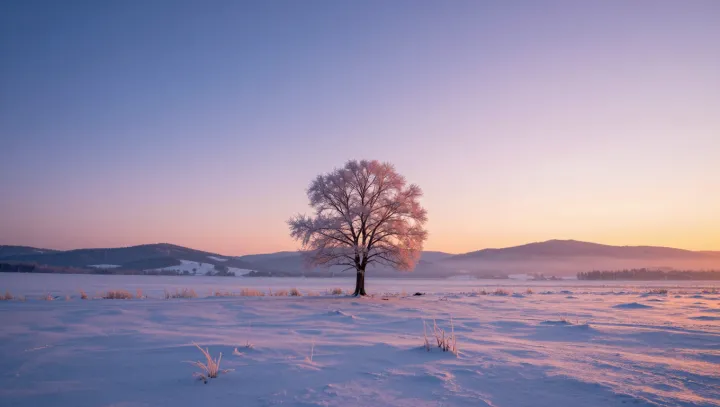
Cold does not kill a tree by temperature alone; it kills by bad ice. On an open field, the frozen trunk becomes a controlled experiment in phase change, not a helpless victim of the air around it.
Ice stays outside first. That is the tree’s core move. Water in the xylem and spaces between cells freezes earlier, releasing latent heat and holding living cells a little warmer while the night deepens. Because solutes are more concentrated inside each cell, the freezing point there drops, a simple colligative property turned into survival strategy. Water then osmotically flows outward, dehydrating the cytoplasm but keeping it mostly liquid, so sharp extracellular crystals cannot rip internal membranes apart.
Dehydration sounds lethal, yet for a hardy tree it is calculated damage. Cell membranes shift into a more ordered phase, and flexible cell walls bend instead of burst as volume shrinks. In some species, antifreeze proteins and compatible solutes such as sugars and amino acids interfere with ice nucleation and limit crystal growth, a biochemical version of putting sand in the gears. Supercooling, the drop of liquid water below its normal freezing point without crystallizing, buys extra safety until an ice nucleus appears, often kept away from vital tissues by anatomical barriers.
Even the wood conducts this strategy. Xylem vessels and tracheids act as sacrificial compartments where ice can expand and gas bubbles can form, while buds and cambium sit behind insulating bark with altered lipid composition in their membranes. That lone black silhouette on the field is not just enduring the freezer air; it is editing where solid water is allowed to exist inside its own body.