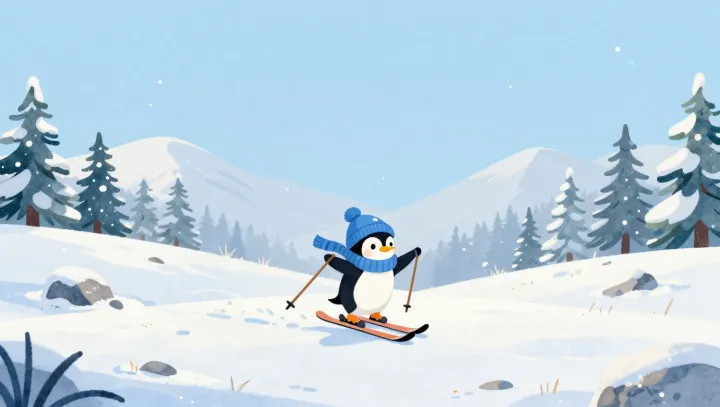
A silent penguin on skis can jolt your nervous system faster than any paragraph about snow and wind. One frame hits. Your visual cortex parses motion, angle, and speed in a fraction of a second, then passes the pattern to the amygdala, which flags risk and reward before conscious language even spins up.
This bias toward pictures is not soft speculation; it is basic neuroanatomy and psychophysics. Visual pathways run in parallel, so slope, texture, and implied friction get computed together, while text demands serial decoding of phonemes, syntax, and semantics. The cartoon compresses vectors, gravity cues, and facial micro-movements into a single shot, prompting mirror neuron activity that lets your body simulate the lean, the wobble, the near-fall.
The real surprise is how soundless exaggeration sharpens the rush. Overstated arcs, elastic timing, and squash-and-stretch animation amplify optic flow and acceleration cues, which the vestibular system reads as a hint of actual motion. A written account must respect grammar and linear order, diluting that surge into clauses and commas. The penguin just drops into the slope and your physiology follows.