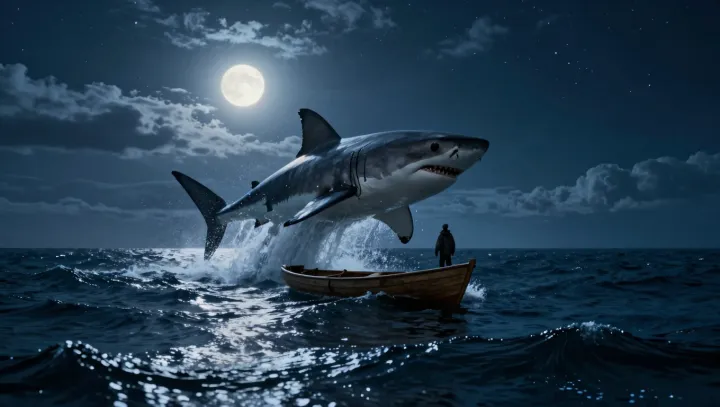
Water, not teeth, is the real weapon here. A great white that weighs like a compact car does not simply jump; it converts a stealth approach into a vertical launch sequence governed by hydrodynamics and muscle physiology. From depth, the shark aligns its body at a steep attack angle, often more than forty degrees, and accelerates along a ballistic path that will intersect the surface beside a target or a boat.
This is less a wild lunge than a calculated strike. By starting deep, the shark gains runway to push water backward with its caudal fin, exploiting Newton’s third law so that each tail beat drives its center of mass forward and upward. Fast-twitch myofibrils in the trunk contract almost explosively, producing power outputs that rival elite sprint athletes but delivered through a massive, crescent tail optimized as a hydrofoil, which minimizes drag and maximizes thrust in dense seawater.
Breach events look chaotic; they are anything but. The shark times its final tail strokes so that maximum thrust occurs just before it reaches the surface, when drag suddenly drops as the body pierces air. Momentum then carries the entire torso, and often the tail, clear of the ocean, even alongside a stationary boat that merely happens to sit along the chosen trajectory. For a brief second, gravity wins again and the predator falls, but the geometry already did its work.