
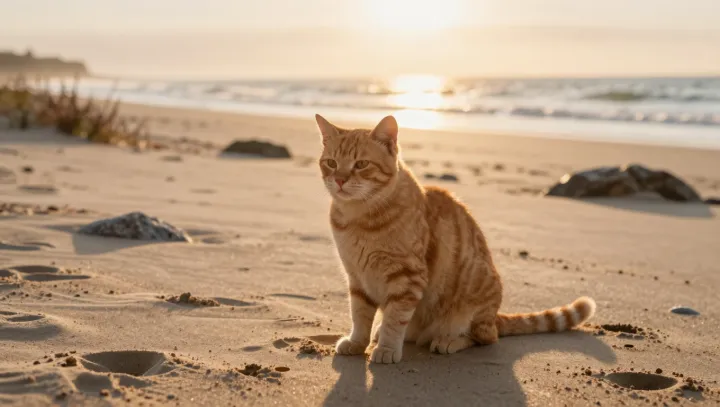
Sunlit fur lies. That ginger tabby by the sea does not sit in peace; it sits in calculation, its nervous system running what ethologists describe as near‑continuous risk assessment while the sky burns orange behind it.
Calm is a performance. Beneath that still posture, the amygdala and hypothalamic circuits fire in brief spikes, integrating sound, scent, and motion far beyond human dynamic range, a form of constant Bayesian updating in flesh that weighs wave crash, gull cry, and distant footsteps against an internal library of past threats and narrow escapes.
Predator and prey both, the cat trusts nothing. Micro‑saccades track horizon shifts, pinnae rotate to run real‑time auditory localization, and mechanoreceptors in the paws read rock vibration, while autonomic balance keeps heart rate just low enough to conserve glucose for a sudden sprint yet high enough to cut reaction latency to a fraction of a blink.
Human observers overrate the sunset and underrate the circuitry. Domestic breeding softened coat color and social tolerance, not the core survival algorithms built from sensory gating, startle reflex, and synaptic plasticity, so the animal can appear almost bored at the water’s edge while its brain conducts a quiet arms race with every shadow.