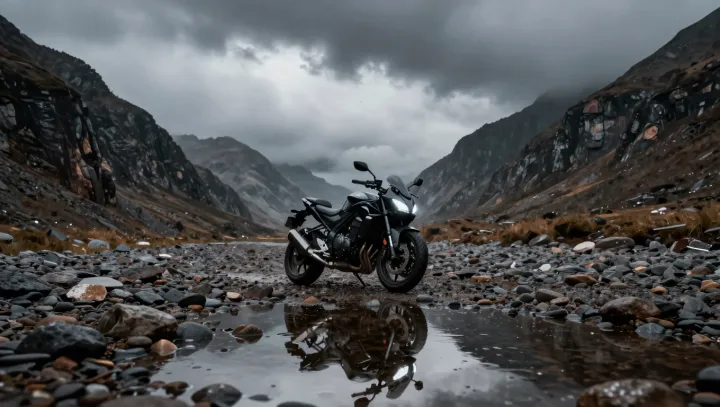
Rain makes the machine look angry. Spray, glare, torn clouds; the bike suddenly seems less like transport and more like intent. What changes is not the fairing or the twin headlights but the context that hits ancient circuitry in the visual cortex and amygdala, tuned for survival long before engines existed.
The claim is blunt: hostile weather upgrades a sportbike into a predator in human perception. Evolutionary psychology and visual neuroscience point to the same mechanism. Under threat, brains bias toward detecting sharp contours, high-contrast edges, and eye-like highlights, a fast pathway that runs through magnocellular channels into fear processing networks. A modern fairing, carved into acute angles to reduce drag and manage turbulent airflow, accidentally fits that template. In clean daylight it reads as design. Against roiling skies it reads as attack.
The second judgment is harsher on the storm than on the bike. Chaos in the background forces the brain to search for order, and anything coherent, bright, and symmetrical wins that contest. Dual LED headlights, spaced roughly like a predator’s forward-facing eyes, trigger long-ingrained face detection algorithms such as those linked to the fusiform gyrus. Add reflective bodywork punching through a curtain of grey, and the machine becomes the most statistically relevant object in view. The storm is noise. The bike is signal.