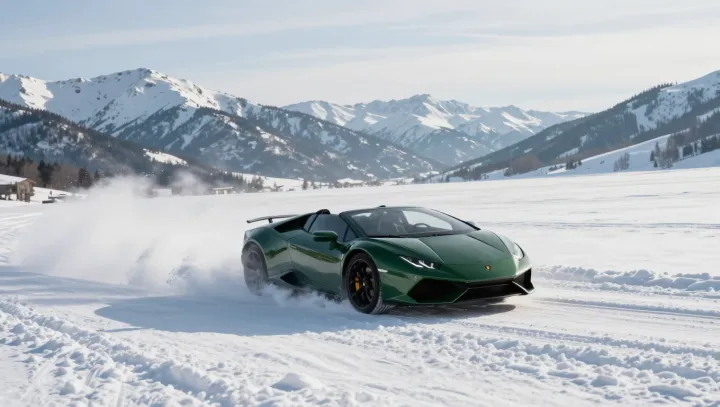
Ice is not the enemy; lazy software is. On a frozen alpine pass, the 600‑horsepower car survives because its brain treats every wheel as a separate problem, not as a single axle. Four speed sensors, a steering‑angle sensor, yaw‑rate and lateral‑acceleration sensors flood a central controller with data every few milliseconds.
Control is won by subtraction. Power goes out, then is clawed back. When a wheel accelerates faster than the car’s body can, the traction control module cuts engine torque and commands the brake hydraulic unit to pinch that corner. Anti‑lock braking (ABS) logic runs in reverse: instead of only preventing lockup, it meters micro‑pulses of pressure to hold each tire just below its peak friction coefficient.
The real trick is attitude, not speed. Electronic stability control watches yaw rate like a hawk; if the nose starts to drift wide, torque vectoring overdrives an inside rear wheel and trims the outer one, creating a corrective yaw moment. With an active differential and brake‑based torque vectoring working together, the car can rotate into the turn while still accelerating, even when the surface offers almost no mechanical grip.
An ordinary car, with crude open differentials and slower control loops, simply cannot run this chess game. Its wheels all spin together, its yaw is mostly unmanaged, and any correction arrives late. On the supercar, algorithms fire so quickly that the driver mostly feels one thing: a heavy, faintly humming calm, where chaos should be.