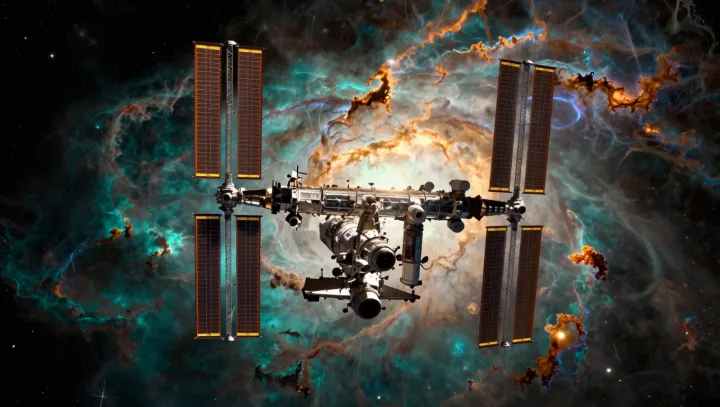
A low orbit is less a place than a balancing act. The space station survives not by escaping gravity, but by surrendering to it in a very specific way. In orbit, the station is in continuous free fall under Earth’s gravity, yet its sideways speed, the orbital velocity, is so high that as it falls, the ground curves away at the same rate. Every instant, the station “misses” Earth again.
The surprising part is that gravity is not the problem; thin air is. Even hundreds of kilometers up, residual atmosphere creates atmospheric drag, a tiny but relentless force that steals energy from the station’s motion. That drag lowers its altitude, which strengthens gravity’s pull and increases drag further, a feedback loop called orbital decay that would end with reentry.
To keep the fall going, engineers treat the station like a satellite in a slow leak. Periodic reboost maneuvers use onboard thrusters or visiting spacecraft to supply delta‑v, small changes in velocity that lift the orbit back up. Those burns restore gravitational potential energy and preserve the delicate match between free fall and forward speed, so the station can keep falling without ever reaching the ground.