
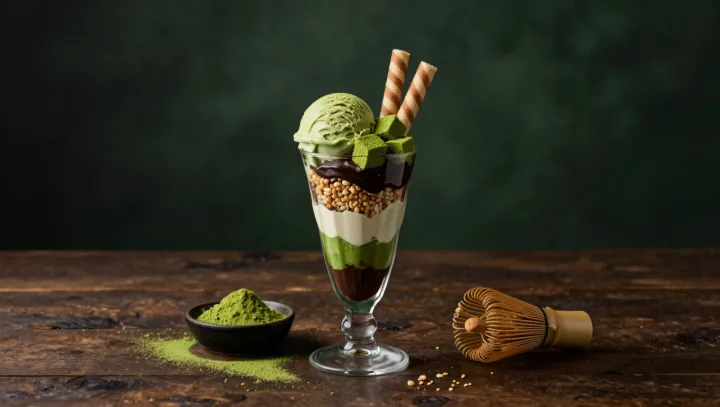
A green scoop changes the rules before the spoon even moves. Where vanilla smooths everything into one gentle register, matcha insists on structure, almost like a quiet tasting menu hidden in a paper cup.
The first claim is simple: matcha makes a sundae less friendly and far more interesting. Vanilla leans on sucrose and fat to deliver a broad, rounded sweetness that coats the palate in one continuous curve, while powdered green tea brings catechin bitterness and umami that interrupt that curve and force the tongue to work through phases of perception rather than one long blur.
More radical is what happens to aroma. A vanilla base pushes a single, linear note of vanillin that matches the sugar arc almost perfectly, but matcha throws out grassy, marine, even nutty volatile compounds that rise faster than the dairy can cushion them, so the nose gets sharp, high-frequency signals while the mouth still holds cold cream and melted syrup, a split-screen experience chefs usually choreograph over several courses instead of a single spoonful.
The real shift, though, is in texture politics. Vanilla ice cream often merges with whipped cream and sauce into one soft mass, yet matcha’s faint astringency tightens the gums and makes crunchy inclusions like nuts or brittle feel louder against the tongue, turning each bite into a sequence of contrast events that mirrors how a tasting menu uses alternating fat and acid, heat and chill, softness and crackle to keep attention awake until the last plate.