
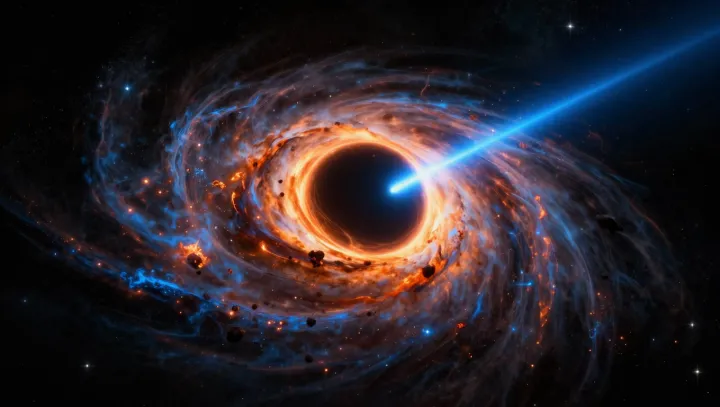
Nothing visible marks a black hole’s edge, yet its presence imprints itself with almost arrogant clarity on nearby light. Around the dark center, hot gas in the accretion disk blazes in X‑rays, while gravity bends those photons into a distorted ring that radiotelescopes can map like a warped halo on the sky.
The bold claim is that this ring outlines the event horizon itself, and the argument rests squarely on general relativity and radiative transfer. Photons skimming close to the event horizon follow curved geodesics, so simulations of spacetime geometry predict exactly how bright arcs and dim gaps should appear when matter orbits at the innermost stable circular orbit, letting observers match real images against theory.
Even the thin jet is not just decoration; it is a pointer. Plasma launched along magnetic field lines by magnetohydrodynamic forces near the black hole’s spin axis forms a relativistic jet, and the jet’s opening angle, brightness profile, and apparent superluminal motion encode the mass, spin, and size scale of the central object, anchoring how far from the center the invisible edge must sit.
Skeptics might argue that this is inference stacked on inference, yet the consistency is hard to dismiss. Independent measurements from very long baseline interferometry, X‑ray spectroscopy, and polarization tracing of magnetic fields all converge on the same radius, sketching an unseen boundary using only tortured light and a needle‑fine stream of matter.