
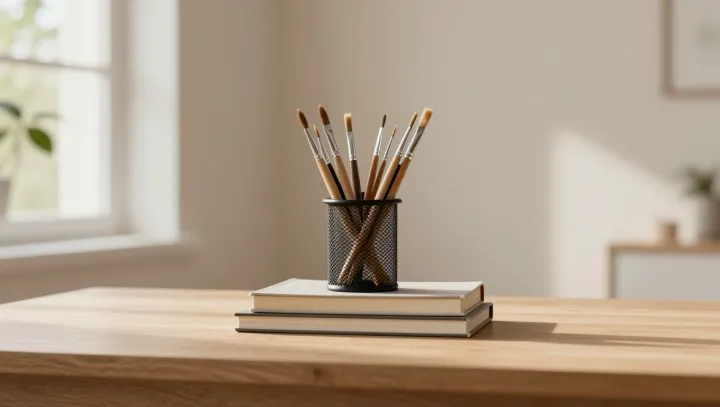
A chipped mug of paintbrushes on leaning books often beats a pristine digital studio at producing original work. The reason is not romance. Cognitive science shows that constraint, mild friction, and sensory variety push the brain into generative rather than optimization modes.
Cheap brushes force commitment. No endless undo stack. No infinite layers. That absence reduces decision paralysis and loss aversion, two effects well documented in behavioral economics. Each stroke carries cost, so attention sharpens, and the prefrontal cortex must actively simulate outcomes instead of outsourcing choices to presets and templates.
Stacked books and scattered tools also matter. Physical irregularity adds micro‑distractions that increase stochastic resonance, a phenomenon in neural signal processing where a bit of noise helps weak ideas cross a threshold. Texture, smell, and resistance recruit more sensory cortices, enriching the associative network that psychologists call divergent thinking.
By contrast, a high‑end digital studio is engineered for efficiency and error reduction. Color‑calibrated displays, latency‑free styluses, and asset libraries optimize throughput. That environment is perfect for refinement and production, but its very smoothness encourages convergent thinking, where existing patterns are reinforced rather than broken open.
For teams hunting the next visual cliché, maximal hardware is a safe bet. For anyone trying to see what does not yet have a name, a few stubborn brushes in a noisy corner quietly stack the odds.