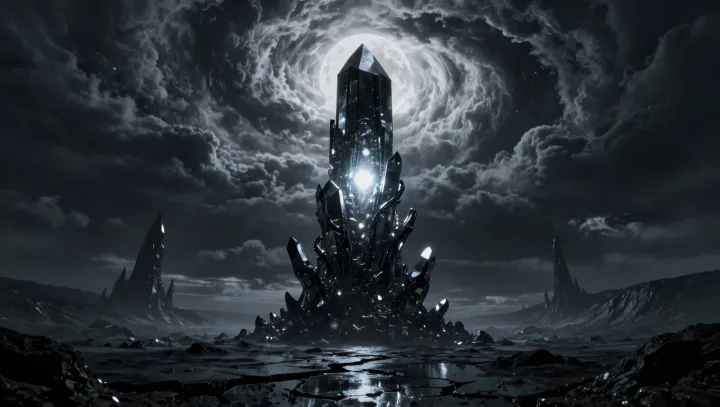
The harsh truth is that a real glowing energy core would look disappointingly boring from the outside. Any column bright enough to light a skyline behaves like a furnace, and thermodynamics does not care about visual drama. Radiant heat, ionizing radiation, and electromagnetic forces climb so fast with power density that aesthetics become a side effect, not a goal.
Designers would start with materials, but not with fantasy alloys. Structural shells would likely be nickel‑based superalloys and ceramic matrix composites, wrapped in graded radiation shielding that mixes high‑Z metals with hydrogen‑rich layers. Those skins would sit behind a sacrificial inner liner, expected to erode under neutron flux and thermal cycling, replaced in modular segments like worn brake pads.
Cooling is the real tyrant. To let a bright spiral remain visible, engineers would hide a brutal heat‑rejection machine behind every clean surface: liquid metal or high‑pressure water in microchannel heat exchangers, active cooling loops driving heat to external radiators, and maybe cryogenic circuits near superconducting coils. The governing equations are Fourier’s law and radiative heat transfer, not concept art.
Support structure becomes less a frame and more a containment cage. The tower would use exoskeleton trusses in high‑strength steel or carbon fiber reinforced polymer, decoupled from the core by sliding bearings and dampers to handle Lorentz forces from magnet systems and blast loads from worst‑case failures. Inside, transparent sections would not be glass; they would be layered aluminosilicate or sapphire panels, kept cool and slightly darkened, so the public sees a controlled glow rather than weapon‑grade daylight.