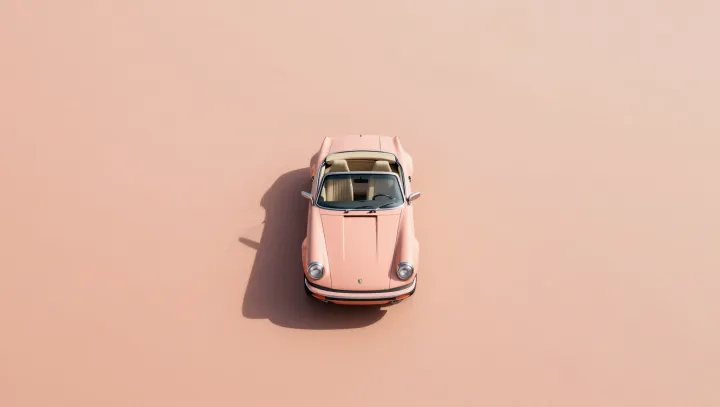
A bare frame of color makes a vintage convertible feel heavier, faster, more dangerous. One hue. One shadow. Nothing else. By erasing background noise, the image forces the eye into a single closed-loop of attention, where the body line and the roofline read almost like a technical drawing.
This stripped scene works because perception is ruthless. Human vision leans on figure–ground segregation and edge contrast, so a car isolated against one field of color gains visual mass and authority, while its shadow functions as a vector, implying direction and torque without showing motion blur or crowds. Add chrome, signage, spectators, and the eye fragments into micro-tasks, each reflection competing for bandwidth, each highlight weakening the car’s dominance in the frame.
Minimal color also rewrites time. A single tone flattens context, erasing fashion, storefronts, even era cues, so the convertible stops being nostalgia and starts reading as archetype, almost like a patent sketch animated by light. That one shadow keeps it grounded, anchoring fantasy to asphalt, letting the car feel not just beautiful, but capable of violence the moment the key turns.