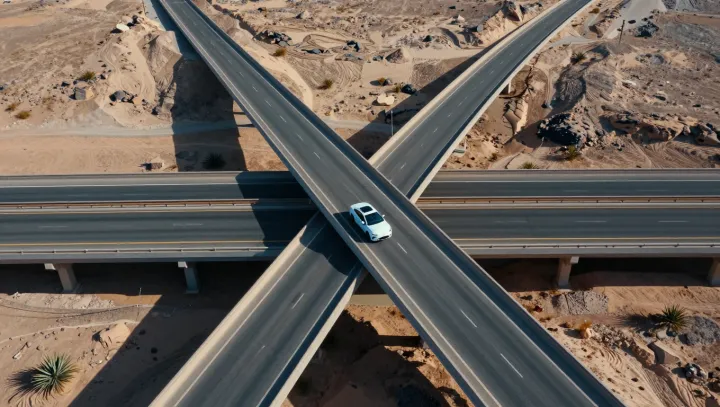
Empty sky beside a thin guardrail makes the wrong body part panic first. Hands. They clamp down. Arms lock. Yet the safest drivers on those exposed curves do the opposite, because control on an overpass is founded less in muscle force than in how the brain processes visual motion, or optic flow, across the windshield and the edge of peripheral vision.
The counterintuitive rule is simple. Look absurdly far ahead. Not at the lane stripe humming under the bumper, but at a distant point where the road seems to vanish, so that steering responds to slow, stable changes in angle instead of the jitter of nearby expansion patterns. By stretching the gaze, drivers smooth the input to the vestibulo ocular reflex, the system that keeps the eyes level as the inner ear senses motion, and that calmer signal translates into smaller, cleaner steering corrections instead of frantic micro turns.
Tight grip, by contrast, is a false comfort. It magnifies every tremor from shoulder and wrist, couples anxiety directly into the steering column, and amplifies the small lateral oscillations that tire engineers call limit cycle behavior. A lighter hold lets the vehicle’s own yaw stability and tire slip angle do their quiet work while attention stays outsourced to the horizon, where danger actually forms, not at the driver’s white knuckles.