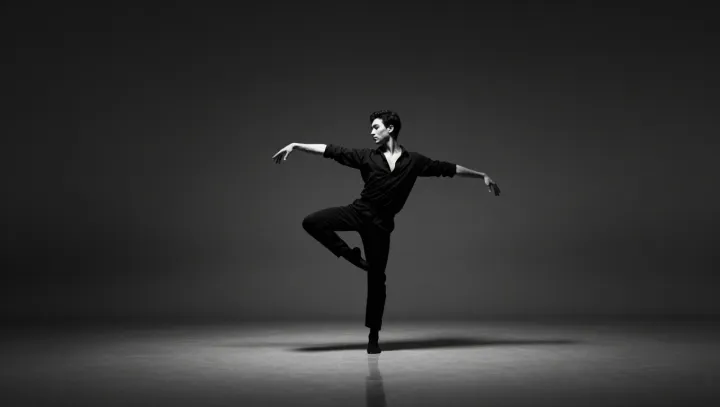
A still frame from a dance often tells the truth that moving footage politely hides. Freeze the body, and the pose becomes a diagram, not a blur; in that suspended instant, the center of mass, the base of support, and the line of gravity line up in ways that even a trained eye can miss when everything is in flux and the visual system is busy stitching motion together.
What looks like more information in continuous choreography is, in practice, noisy data. The nervous system excels at smoothing, so spectators perceive grace, not raw mechanics. A single static pose, by contrast, exposes the torque around each joint, the ground reaction force under each foot, and the exact vector of momentum implied by the lean of the torso or the angle of an arm, much like a free‑body diagram used in classical mechanics to strip a situation down to forces and directions alone.
Counterintuitively, subtraction is what sharpens understanding here. Remove motion, and kinematics pause, leaving pure geometry and load paths: where weight travels through the skeleton, how friction at the floor must counter sliding, how a tiny shift of the pelvis repositions the projected center of mass over a razor thin support. On a paused image, coaches can draw vectors, trace joint angles, and quantify balance with biomechanical precision that no slow‑motion replay can quite match.