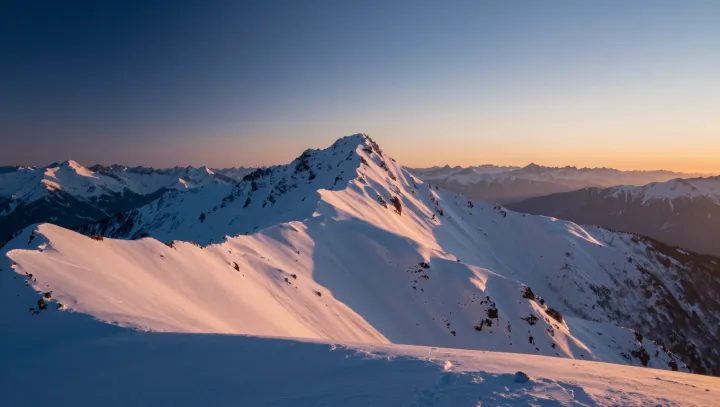
Flat snow on your screen is not a camera failure; it is a perception failure. A single frame strips away binocular vision, motion parallax, and subtle focus shifts that visual cortex normally fuses into a sense of volume. What remains is a white sheet with faint gray stains where you remember towering peaks.
Depth has to be rebuilt on purpose. Photographers who accept this, and stop blaming sensors, start to compose like engineers of space, stacking ridge after ridge to create atmospheric perspective, then letting contrast and occlusion do the work your missing second eye once did. A distant peak gains authority only when a nearer ridge partially cuts across it, setting up clear z-order in the frame and giving the viewer a readable depth hierarchy.
Light direction is the second non‑negotiable. Side light carves micro‑relief into snow by exaggerating luminance gradients, which your brain reads as surface normals and contour. When light skims across the slope, tiny shadows along cornices and creases generate local contrast that no flat front light can match, turning white mush into sculpted mass.
Most decisive of all is a bold foreground line. A ski track, a rock edge, a sinuous ridge lip: each acts as a leading vector that begins at the frame edge and pulls the gaze inward through linear perspective. Anchor that line low, aim it toward the highest peak, and the viewer’s eye does the climb your body remembers.