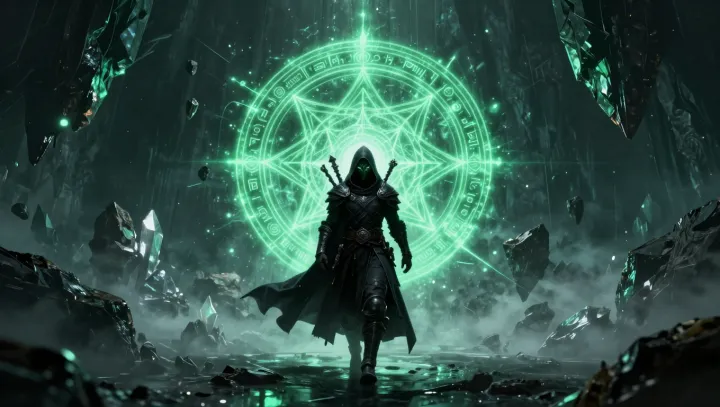
A hovering rock fortress is not just hard; under normal physics it is essentially forbidden. A kilometer-wide chunk of stone carries so much self-gravity and internal stress that ordinary compressive strength and tensile strength cannot keep it rigid without massive buttressing, let alone hold it motionless in air.
The least exotic fix is brutal: replace magic with force fields. Continuous magnetic levitation using diamagnetism or superconductors could, in principle, balance weight, but only if the fortress is laced with conductive or superconducting material and sits inside planet-scale coils or magnetic bearings. That turns the sky into an engineered machine, not a backdrop. Static equilibrium here is a power grid problem, not a fantasy image.
More radical is to attack gravity itself. General relativity allows space-time curvature to be modified by stress-energy; hypothetical negative mass or Casimir-like vacuum engineering could generate local gravitational wells that cancel the fortress’s weight, a kind of gravitational shielding that does not exist in standard matter. The structure would then float because the metric says down no longer points the same way. Yet every such scheme demands exotic matter and energy densities beyond any known material science, making those serene sky castles less like architecture and more like contained singularity experiments.