
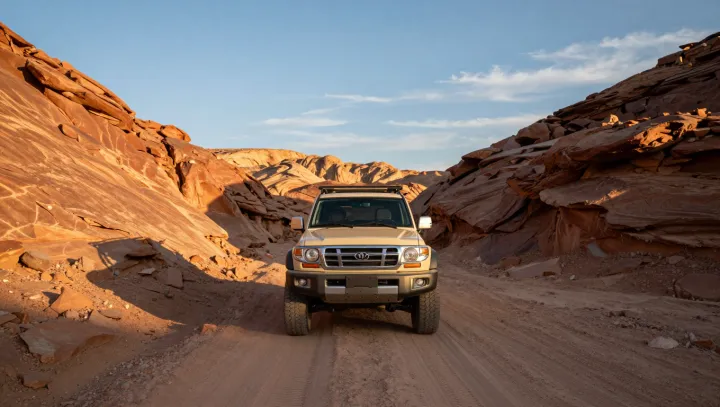
Heat shimmer on the horizon tells the truth long before a spec sheet does. In desert guiding culture, horsepower is treated as background noise, because the real constraint is terrain physics and thermal stress, not straight-line thrust. A steep dune face turns into an engineering filter, exposing approach angle limits, suspension geometry flaws, and cooling system shortcuts that glossy marketing never admits.
Guides insist that approach angle matters more than peak power because impact loads and breakover risk decide whether a vehicle advances or digs in. The contact patch, not the pedal, sets the pace. One misjudged crest and a low bumper becomes an anchor. Long-travel suspension with real articulation and proper axle droop keeps tires in contact as sand ridges deform, exploiting friction and weight transfer instead of brute acceleration that only spins and overheats.
Their harshest bias, though, is against weak thermal management. In deep sand, engines run near wide-open throttle, and cooling systems fight continuous high load. Heat soak is not a theory; it is coolant boiling in the overflow and automatic transmissions slipping into limp mode. Radiator surface area, intercooler placement, and fan duty cycles become survival variables, because a disabled SUV miles from shade is not an inconvenience. It is a liability with a VIN.