
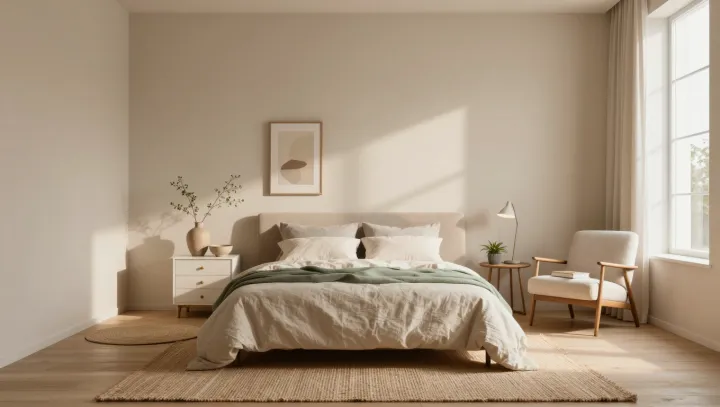
Soft morning light makes the first argument. Against bare floors and minimal furniture, that low-angle glow flattens harsh contrast and lowers visual noise, a condition environmental psychologists link to reduced cortisol and steadier heart rate. In a room that holds almost nothing, light becomes the main signal, and a gentle signal tells the nervous system there is no threat waiting in the corners.
Muted beige walls add a quieter kind of safety. Not because beige is trendy, but because low-saturation hues sit near the center of the visual spectrum and demand less work from the visual cortex, easing perceptual load in a way not unlike sensory gating in cognitive neuroscience. Edges blur a little, shadows soften, and the brain receives a stable background field instead of a jolt of contrast every time the door opens.
Most persuasive, perhaps, are the plants. A couple of pots are enough. Studies on biophilic design and autonomic regulation show that even small doses of foliage can lower sympathetic arousal and steady breathing. Soil, new leaves, a stray fallen stem: each tiny irregularity announces that the room has a past and a future. In that modest evidence of ongoing care, an almost-empty bedroom quietly stops feeling vacant and starts reading as lived in, and therefore safe.