
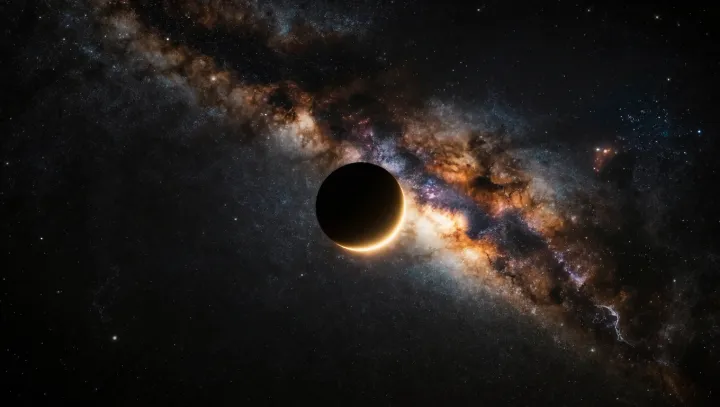
A ring that bright around a disk that black is not a paradox; it is gravity showing off. A perfectly dark, planet-sized silhouette can still burn with a razor-thin halo because light does not travel straight in warped spacetime, it is herded. Every passing photon is dragged, deflected, or trapped by the same general relativity equations that describe a black hole shadow.
The striking part is that the darkness is almost irrelevant; geometry does the work. When mass curves spacetime enough, null geodesics bend into near-circular paths, forming a so-called photon sphere that stacks multiple light trajectories into a narrow ring. Rays that skim the edge loop around once, twice, even more, before escaping toward a distant telescope, compressing many paths into a thin, intense outline.
The bolder claim from astronomers is that this ring is a signature, not an illusion. Interferometric arrays that target supermassive black holes extract that sharp rim by combining signals across vast baselines, resolving scales close to the event horizon itself. What they record is not the black hole, which by definition emits nothing, but this gravitationally forged ring that marks where light almost failed to get away.