
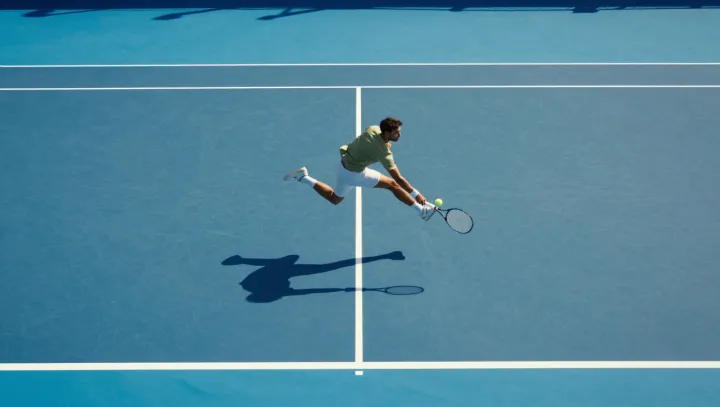
Contact with acrylic hard court, not courage, decides whether a dive is nonsense or a rational gamble. That sliding impact is a crude physics engine: once the player leaves the ground, linear momentum, friction, and angular momentum start running the point more efficiently than feet ever could.
The harsh truth is that staying upright kills reach. A sprinting player must keep their center of mass above the feet, so the racket tip travels on a tight leash. By jumping and committing to a full dive, the body turns into a low-flying projectile; horizontal momentum carries the shoulder and racket several extra racket-lengths, while the arm can fully extend without the constraint of balance recovery.
The real trick is how friction becomes an ally. On first impact, kinetic friction between skin or clothing and the acrylic surface bleeds speed in a controlled skid, converting part of the horizontal kinetic energy into a manageable deceleration instead of a sudden stop. That sliding window, often a fraction of a second, keeps the racket moving along the ball’s path long enough to adjust the face angle and produce a playable deflection rather than a random poke.
Rotation then upgrades chaos into control. As the diver hits the court, off-center contact generates torque around the body’s center of mass, feeding angular momentum that swings the torso and racket toward the ball’s predicted position. This involuntary roll, governed by rigid-body dynamics, effectively sweeps a bigger arc through space; the racket samples more of the possible ball locations, which raises the probability that one of those positions intersects the incoming trajectory at a usable angle. The price is bruised skin. The reward is a non-zero save rate where normal footwork offered none.
That is why the most spectacular dives are not just highlight-chasing stunts but cold physics decisions: when the expected value of a controlled skid and roll beats the certainty of losing the point, the rational move is to leave the ground.