
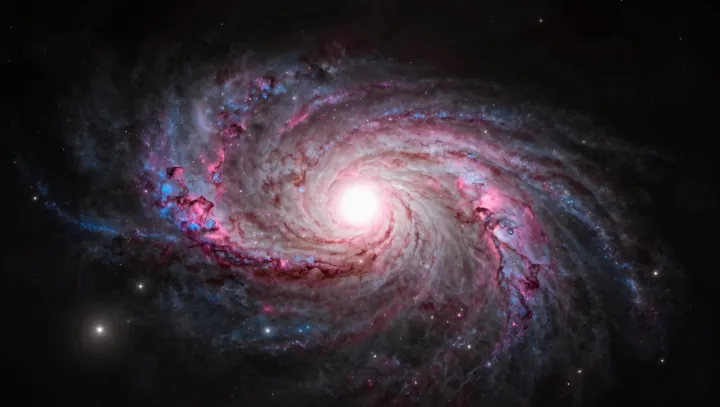
Blazing cores may be safer. Not the quiet outskirts. In spiral galaxies, the inner bulge hoards mass, metals and energy, while the suburbs drift in thinning gas and rising exposure to the intergalactic medium.
That reversal matters for life. High metallicity in the core feeds planet formation, supports dense protoplanetary disks and boosts the odds of rocky worlds with long-lived radiogenic heat, a key driver of plate tectonics and magnetic dynamos. Outer disks, starved of heavy elements, tend to build smaller, colder systems that may freeze geologically and lose their global magnetic fields much earlier.
Radiation, often blamed on the core, can cut both ways. Near the center, overlapping magnetic fields, thick gas and dust lanes filter some high-energy cosmic rays, while stable, low-mass stars can orbit in relatively sheltered niches between active regions. Farther out, shielding falls, and a single nearby core-collapse supernova or gamma-ray burst can strip atmospheres across wide swaths of the disk.
Long-term stability may tilt inward. Star formation in many spiral cores winds down into a slow, steady mode; fewer massive short-lived stars means fewer cataclysmic events, while existing low-mass stars can shine with near-constant luminosity for spans that dwarf typical biological timescales. In contrast, outer regions can keep sporadically forming massive stars, injecting shocks, ultraviolet radiation and dynamic perturbations into planetary orbits.
So the bright center, often painted as hostile, starts to look like a crowded but durable neighborhood, its glare masking a deeper kind of safety for any chemistry patient enough to wait.